Recently we removed a wasp nest from home and instead of throwing it away I decided to preserve it.
It is about 3 1/2" in diameter. The nest is made of layers of paper like material. There is a caterpillar inside too, stored food for later use?
Inside are cells
The top one is the worker. Down below are two bigger wasps from the same nest. One is the queen, and the other one I am not sure. Male?
A clever and super creepy double entendre PSA about invasive insects and the need to be careful about out firewood habits in terms of invasive insects and tree diseases from the folks at dontmovefirewood.org
Just how far can we liken the spread a tree pests to that of human STDs? You be the judge....
"Some Ecuadorian tribes were famous for making mummified shrunken heads from the remains of their conquered foes. Field work in the cloud forests of Ecuador by Professor Scott Shaw, University of Wyoming, Laramie, and colleagues, has resulted in the discovery of 24 new species of Aleiodes wasps that mummify caterpillars. The research by Eduardo Shimbori, Universidade Federal de São Carlos, Brazil, and Scott Shaw, was recently published in the open access journal ZooKeys.
Among the 24 new insect species described by Shimbori and Shaw, several were named after famous people including the comedians and television hosts Jimmy Fallon, John Stewart, Stephen Colbert, and Ellen DeGeneres, as well as the Ecuadorian artist Eduardo Kingman, American poet Robert Frost, and Colombian singer and musician, Shakira."
"In a Flood, Ants Really Come Together", they can link their bodies together to create buoyant rafts to protect the queen and her brood. It's amazing to see how flexible they are when they bond together! "Worker ants are dispersed throughout the raft and form a dome atop the base and around the queen. This position allows them to recover quickly once the colony emerges from the flood so they can aid the queen and the brood." Check out the video: http://nyti.ms/1cOGI7l
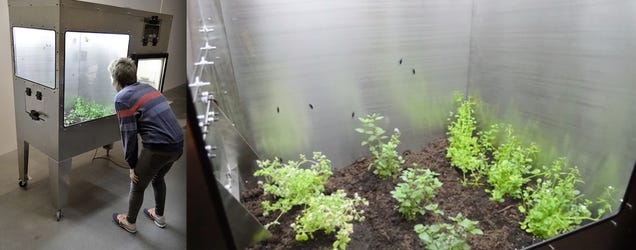
Icelandic designer Búi Bjarmar Aðalsteinsson has built a prototype of a "Fly Factory", a self-contained insect farm that could be installed in a greenhouse or commercial kitchen. When its on the market it could potentially make it even more possible for people to substitute meat with insects and reap the environmental benefits. Check out the article - THIS INSECT FARM GROWS LARVAE FOR YOUR DINNER. ~Emma Sims
Found some artists who like to work in collaboration with some bees that I thought were wonderful. The first piece, "We Are But Dust & Shadow" was about the pleasure of making which I found to be quite interesting.
I stumbled upon this petition claiming that the decrease in the population of honey bees is due to a a pesticide called "neonics" that is sold by Home Deopot and Lowe's.
Co-evolution! Many plants, such as violets, wild ginger, trillium, bloodroot, trout lilly (all out and about on my last walk in the forest preserve), use ants to disperse and bury their seeds by producing nutrient rich appendages on their seeds specifically for their consumption! ^o^ Awesome.
A new research programme aims to understand 3D vision in the praying mantis, the only invertebrate known to have this ability, and compare it with vision in humans.
Analysing how mantises see in three dimensions could give us clues about how 3D vision evolved and lead to novel approaches in implementing 3D recognition and depth perception in computer vision and robotics.
The team, led by Dr Jenny Read from the Institute of Neuroscience at Newcastle University, has been funded by a £1M Research Leadership Award by the Leverhulme Trust to characterise the mechanisms of 3D vision in mantises and how these mechanisms can be applied in science and industry. See a video of the research.
Dr Read said: “Despite their minute brains, mantises are sophisticated visual hunters which can capture prey with terrifying efficiency. We can learn a lot by studying how they perceive the world.”
Dr Vivek Nityananda, Newcastle University Institute of Neuroscience is one of the investigators involved in the study. He said: “This is a really exciting project to be working on. So much is still waiting to be discovered in this system. If we find that the way mantises process 3D vision is very different to the way humans do it, then that could open up all kinds of possibilities to create much simpler algorithms for programming 3D vision into robots.”
3D vision
It is also possible that 3D vision in mantises is closer to that of vertebrates, where disparities between the positions of an object’s image in the two eyes can be detected and used to reveal the object’s position, even when the object is camouflaged and thus invisible in either eye individually. This would mean that mantises have independently evolved similar 3D processing to vertebrates – a fascinating insight into the evolution of 3D vision.
A key component of the research entails presenting virtual 3D stimuli, such as moving targets within the visual field of the mantis. As a first approach, the researchers are attaching a pair of 3D glasses – the world’s tiniest – with beeswax to the mantis, and placing it in front of computer-generated images, presented on computer monitors. After the experiments, the scientists remove the beeswax and the glasses, and place the mantises back in the insect room where they are fed and maintained.
Dr Nityananda added: “We can do this by fooling them into misjudging depth, in the same way that our brains are fooled when we watch a 3D movie.”
The experiment will determine if mantids can see the moving object standing out in depth in a similar way to humans and monkeys.
The research project will use data from behavioural observations as well as electrophysiological recordings to help model potential neural algorithms that can be used in technology while simultaneously shedding light on the evolution of 3D vision in the natural world.
This is the first major research project investigating these mechanisms following the discovery made by Samuel Rossel in 1983 that praying mantises have 3D vision. Rossel conducted successful experiments by placing prisms over their eyes and creating an optical illusion that an object was within their range, thus triggering a strike from the mantises.
Canadajournal/Press Releases
From Allana Williams
I found this article very interesting. As a film student, it is interesting to see that scientists are applying a technology mainly used by the public in movie theaters on an insect, the praying mantis, to try to potentially model neural algorithms.
"A Chinese beekeeper She Ping covered his half naked body with nearly half a million bees in order to sell more honey, and managed to walk away with only slightly more than 20 stings, he said."
I saw news about this man wearing bee suit when I was little, maybe when I was in elementary, and he is still doing this!!
"I first did this at 22, just for fun and out of curiosity. Later on, I would put on the bees just for the sake of making people believe I sell actual real honey," Ping said. And Ping is 34 years old now.
"The bees are usually attracted onto the body by trapping and attaching the queen bee somewhere to the body." -Kelly Feng
So I was arranging some of the 35mm film picture I took in the past couple years when i was in China, and found there are different orders of hexapod and a pic of a house centipede . The house centipede (Scutigera Coleoptrata) is not an insect, but an arthropoda (which i didn't know until i took this class!). I think they are quite beautiful and want to share them with you :)
As I am doing additional research for my Zine project on Monarch Migration I have stumbled across this beautiful video of a Monarch overwintering site in Mexico! This video is from 2008, when Monarch migration was still very much in abundance and flourishing.
Unfortunately, the Monarch Migration has suffered a great deal in recent years as Monarch numbers continue to dwindle due to increasing presence of GMO pesticides in corn fields all over the country, and all of this dramatically changing weather we've experienced in the US recently. Sadly, more and more Monarchs die on the first leg of their migration, these factors become too much for them to conquer! Poor Monarchs.
Great movie with Sophia Loren that highlights the complicated nature of kin selection.
http://www.amazon.com/Marriage-Italian-Style-English-Subtitled/dp/B0053TLD3G