 The Gene Siskel Film Center recently screened this charming and odd film about the Japanese fascination with insects: Beetle Queen Conquers Tokyo. This is a cultural sensibility I can really get behind and feel kindred with, perhaps for obvious reasons. Some of the editing was a little strange and it would have been nice to get a wider spectrum of how insects run through Japanese culture (the TV shows for kids!), but wonderful all the same.
Thursday, September 17, 2009
Beetle Queen Conquers Tokyo!
The Gene Siskel Film Center recently screened this charming and odd film about the Japanese fascination with insects: Beetle Queen Conquers Tokyo. This is a cultural sensibility I can really get behind and feel kindred with, perhaps for obvious reasons. Some of the editing was a little strange and it would have been nice to get a wider spectrum of how insects run through Japanese culture (the TV shows for kids!), but wonderful all the same.
Sunday, September 13, 2009
The Insects of Montrose Beach!

It was a perfect day for looking around for insects. First trip out for the Insect World class, Fall 09 and we were on the hunt.

M. made a close inspection of the trees and the bark.....

and hit it big with a beetle by baiting it out of a nook with a twig, which the beetle grabbed and she then fished out of the crevice!

J. was the all around champion in catching dragonflies, this one being the first of the day.

Monarch butterflies were also around, it being early fall, after all.

And although we heard plenty of cicadas singing, and even saw a few in higher branches, the closest we actually got to one were the molting shells still left on the tree trunks from late spring...

Some quite unexpected things were found hanging around as well, like this cute bat(!) hanging upside down from the sturdy leaves of a tall, weedy plant. J.S. thought it was a big bug at first - thankfully she didn't get it caught up in her net. An utterly amazing thing to come across.

Grasshoppers were hopping, as would be predicted. I let this one go after letting it smile for the camera.

Caterpillars were woolly and wily and walking around the weeds (milkweeds mainly)

All in all, a very successful first day out....!
AY
Wednesday, July 15, 2009
pets
 Alexandra and I went to Chevalier Woods yesterday and found a few adolesent praying mantis. They are only about an inch long, i took one home and have the little guy, or girl, in a pickled okra jar with a few flies.
These Grapevine beetles (pelidnota punctata) congregate at the 'L' stops by my house, I gathered a few and decided to keep them as pets. They are about an inch long, but sometimes grow up to an inch and a half. As their name suggests I have been feeding them Grapes.
thought you'd appreciate
-kara
Wednesday, March 25, 2009
Beetles getting "to the point"

Beetles love fancy horns. This slideshow from the New York Times shows quite an array indeed. An article about Dr. Emlen studies with my old advisor Fred Nijhout.
Tuesday, February 10, 2009
Aztec insect good eats
The Aztec World exhibit is currently at Chicago's Field Museum, and one intriguing part (which I unfortunately missed) was the Aztec insect eating event.
Monica Eng - food writer for the Chicago Tribune - samples some of the dishes in this video!
Monica Eng - food writer for the Chicago Tribune - samples some of the dishes in this video!
Friday, January 30, 2009
Buggy Blagojevich?
 Today our new governor of Illinois, Patrick Quinn, announced the following:
"We've had a body blow to our politics and government in the last seven weeks and two days but that's over," Quinn said at a news conference. "Today is a beginning, a start. ... We're going to start to fumigate state government from top to bottom to make sure it has no corruption."
For ex-governor Blagojevich, perhaps this is an appropriate metaphor - or should we say "metamorphosis"? Indeed, Rod-as-Bug seems to be in the collective unconscious right now, if this print for sale on Etsy.com is any indication.
Oh, but the insects do get a bad rap. Fumigate? Impeachment might be enough: I'll take a fly to the ex-governor any day of the week...
Sunday, December 14, 2008
award winning photo of fairy fly

this image has received acclaim for the photographer capturing this fairy fly's wings. national geographic released a short article about it here.
-kara
Monday, December 8, 2008
Secret Society Of Superorganisms

NPR recently did a nice very interview of E.O. Wilson and Bert Holldobler on their new book on "superorganisms."
Beyond the audio, they also have a nice slideshow that they put together for the peice!
As many of you know, I am a big proponent of the superorganism concept; if you'd like to read a recent paper on the topic I wrote, feel free to check it out, available HERE.
andy
Sunday, December 7, 2008
ouch!
As the semester finishes up and you are getting your insect collections together, something to think a bout more long term: pet management. Yes, even though your insects are dead, your collection can still (most unfortunately) generate insect pests.
Why mothballs in the insect cases? We talked about how dermestid beetles might try to infiltrate and eat your specimens - last night I found some first hand evidence of this phenomenon in a collection box I had neglected to protect. The pictures below show the damage:

my poor bee mimic! You can see the pupal cases littered around as little yellow flecks...

my carpenter bee too.....

the monarch as well!

And here is the culprit, at least one of them, that was sitting on the outside edge of the box. Protecting your insects from thee guys is something to consider if you want your lovely collections to survive in perpetuity...
andy
Why mothballs in the insect cases? We talked about how dermestid beetles might try to infiltrate and eat your specimens - last night I found some first hand evidence of this phenomenon in a collection box I had neglected to protect. The pictures below show the damage:

my poor bee mimic! You can see the pupal cases littered around as little yellow flecks...

my carpenter bee too.....

the monarch as well!

And here is the culprit, at least one of them, that was sitting on the outside edge of the box. Protecting your insects from thee guys is something to consider if you want your lovely collections to survive in perpetuity...
andy
Saturday, December 6, 2008
Ants at Work
Some remarkable footage of what ants can do - in this case recycling the biomass of a dead garden gecko in a matter of hours.
andy
Friday, December 5, 2008
super ants taking over world
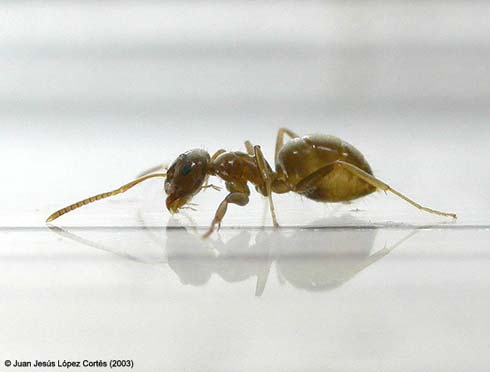
the ant species lasius neglectus is taking over Europe and wiping out native ant species as well as local plants.
The species originated in the black sea region has invaded more then 100 areas across Europe and is on the move. read more at http://www.livescience.com/animals/081203-ant-invasion.html
-kara
Sunday, November 30, 2008

 If you'll recall much earlier in the semester we talked about the recent research showing the gold medal for the fastest mandible strike in nature goes to trap-jaw ants (video).
Now it seems my friend Marc Seid and his colleagues have found a termite has bested the record!
As Marc is quoted :
"Ultimately, we're interested in the evolution of termite soldiers' brains and how they employ different types of defensive weaponry," says Seid. Footage of the soldier termite's jaws as they strike an invader at almost 70 meters per second was captured on a high speed video camera in the laboratory at 40,000 frames per second. "Many insects move much faster than a human eye can see so we knew that we needed high speed cameras to capture their behavior, but we weren't expecting anything this fast. If you don't know about the behavior, you can't hope to understand the brain," Seid adds.
There is always a faster gun out their in the Wild West in the insect world....
andy
Leafcutter flag wavers (Donna Conlon)

Just a follow up on the artist I mentioned in class (Donna Conlon) that played with the leaf-carrying on leafcutter ants. To see an excerpt of the video:
http://www.donnaconlon.com/list_en.php?gal_id=62&cat_id=18
andy
Leafcutter bacterial symbiosis update

As we've been exploring the complex web of mutualisms, predation, and parasitism in the fungus-gardening leafcutting ant system here is a research update straight from the lab of Cameron Currie, providing more detail on the coevolving "arms race" between
the baterical that produce anti-pest compounds which wad off pest-fungal species from taking over the garden.
http://www.sciencedaily.com/releases/2008/11/081122075126.htm
The article also clarifies a point we didn't discuss uly in classbut wshich is an imporant one in therm so thinking about the bacteria/ant mutualism - is it only a place to grow that the bacteria get in exchange for teir anti-pest activites? Apparently not:
So what do the bacteria get out of producing pesticides for the ants? "For starters, they get food. Many species of fungus-growing ants have evolved special crypts on their bodies where the bacteria live and grow. Scientists believe that the ants feed the bacteria through glands connected to these crypts," said Dr Garret Suen, a post-doctoral fellow in Professor Currie's lab. "Also, the bacteria get a protected environment in which to grow, away from the intense competition they would face if they lived in other environments such as the soil."
andy
Tuesday, November 25, 2008
Dinosaur that specialized in devouring termites

The smallest dinosaur known to live in North America had a particular fondness for termites. With stubby little arms, long claws and tweezer like mouth parts the little guy was specialized in ripping apart termite mounds to feast the colonists.
http://blogs.discovermagazine.com/80beats/2008/09/24/tiny-seussian-dinosaur-shredded-logs-to-find-termite-snacks/
News Flash: Ants can make drawings and destroy flags


Artist Yukinori Yanagi utilizes ants and ant farms to make some spectacular work
check it out
http://www.iniva.org/dare/themes/space/yanagi.html
Thursday, November 20, 2008
Video Proof of Wasp Face Recognition!
"Video of a wasp choosing between two patches of food. The wasp chooses based on the facial patterns of the guards, preferring the patch guarded by the opponent with fewer black facial spots."
The Tibbetts Lab page, and the videos and pictures page.
andy
Tuesday, November 18, 2008
Locust Swarms Plague Australia

From the BBC News:
Vast swarms of locusts have been spotted in Condobolin, Wagga, Gundagai and Narrandera - some up to six kilometres long.
New South Wales Primary Industries Minister Ian Macdonald talks about the government's preparations to deal with them.
Locusts feed mainly on green vegetation. New South Wales is approaching its harvesting season, and in some areas, this is the first successful crop after years of drought.
See the Video HERE!
Also check out the video on the spread of the "Toxic Moth"!
Spiders in Outer Space

Apparently, yes, on the international space station as we speak! Part of some on-broad experiments, including seeing how their webs turn out in zero-gravity.
When you read the article you'll notice a little error that gave me the latitude (altitude?) to feel like this news item belonged in the insects news, even if in taxonomic error....
Apparently these spider experiments were done some 30 years before - perhaps the scientists felt it was time for a replicate? Let's hope.
andy
Saturday, November 15, 2008
Hexapod dance, dance, dance......
Given our devotion to living hexapods it is wonderful to see these robotic ones prance around. Interesting out of all the costumes only one or two picked an insect motif!
Maybe too obvious..?
andy
Subscribe to:
Posts (Atom)